

How to Manage Reactive Dog Walks: A Step-by-Step Guide
Table of Contents
- Understanding Your Dog's Reactivity on Walks
- Creating a Safe Walking Environment and Management Plan
- Building a Leash Reactivity Training Plan
- How to Calm a Reactive Dog on a Walk
- Post-Reaction Recovery and Building Handler Confidence
- Walking Your Reactive Dog at Night or in Low-Visibility Conditions
- When to Seek Professional Help
- Celebrating Small Wins on Every Walk
- Frequently Asked Questions
Last Updated: September 21, 2026
Learning how to manage reactive dog walks can feel overwhelming at first. The barking, lunging, and tension, both from your dog and from your own nervous system, can make something that should feel good feel exhausting instead. But here's the truth: how to manage reactive dog walks is learnable. It's not about forcing your dog to be calm. It's about understanding what they're communicating, creating conditions where they feel safer, and building your own confidence one walk at a time.

The strategies that work aren't mysterious, they're practical, grounded in how dogs actually learn, and built on compassion for both you and your dog.
Understanding Your Dog's Reactivity on Walks
Reactivity on walks usually isn't about bad behavior. It's communication. Your dog is telling you something feels threatening, overwhelming, or intensely interesting. The barking, lunging, or freezing is their way of saying "I need help with this."
Reactivity can stem from fear, anxiety, frustration, excitement, overstimulation, pain, or learned behavior, often a mix. Your dog isn't being difficult; they're being honest about what they're experiencing.
Recognizing dog body language signs of stress
Before you can help your dog, you need to read what they're telling you. Dogs speak with their ears, their body posture, and their movement patterns.
Signs your dog is moving into stress or reactivity:
- Ears pinned back or forward and rigid
- Stiff, forward-leaning body posture
- Tail held high and tight, or tucked
- Raised hackles (hair standing up along the spine)
- Fixated stare or intense focus on the trigger
- Panting or rapid breathing
- Yawning, lip licking, or nose licking
- Pulling hard on the leash
- Whining or barking
These are stress signals. Your dog is approaching their threshold, the point where they feel they can't handle the situation without reacting.
After your dog reacts, they often calm down quickly, important context that shows the reaction was about managing stress, not aggression. Once the trigger passes, your dog's nervous system resets. Watch what happens next: Does your dog seem relieved, scared, or energized? These clues reveal whether your dog was afraid, frustrated, or overstimulated.
Identifying triggers and managing threshold distance
A trigger is anything that causes your dog to react. Common triggers include other dogs, people, bikes, cars, or specific situations like narrow paths where escape feels impossible.
Your dog has a threshold distance, the closest they can get to a trigger before they react. This distance varies by trigger, by day, and by your dog's stress level.
How to identify your dog's triggers:
- Keep a simple log for one week. Note what triggered reactions and how close the trigger was.
- Look for patterns. Does your dog react to all dogs or specific types? All people or people in certain clothing or moving certain ways?
- Notice what makes reactions worse: time of day, hunger, previous activity, or existing stress.
If your dog reacts to dogs at 30 feet away, that's their current threshold. The goal isn't to force your dog closer, it's to gradually help them feel safer at shorter distances through training and counter-conditioning.
Creating a Safe Walking Environment and Management Plan
The foundation of managing reactive dog walks is management: setting up walks so your dog is less likely to react. Management isn't permanent, but it's essential while you're training.
Choosing low-stress routes and timing
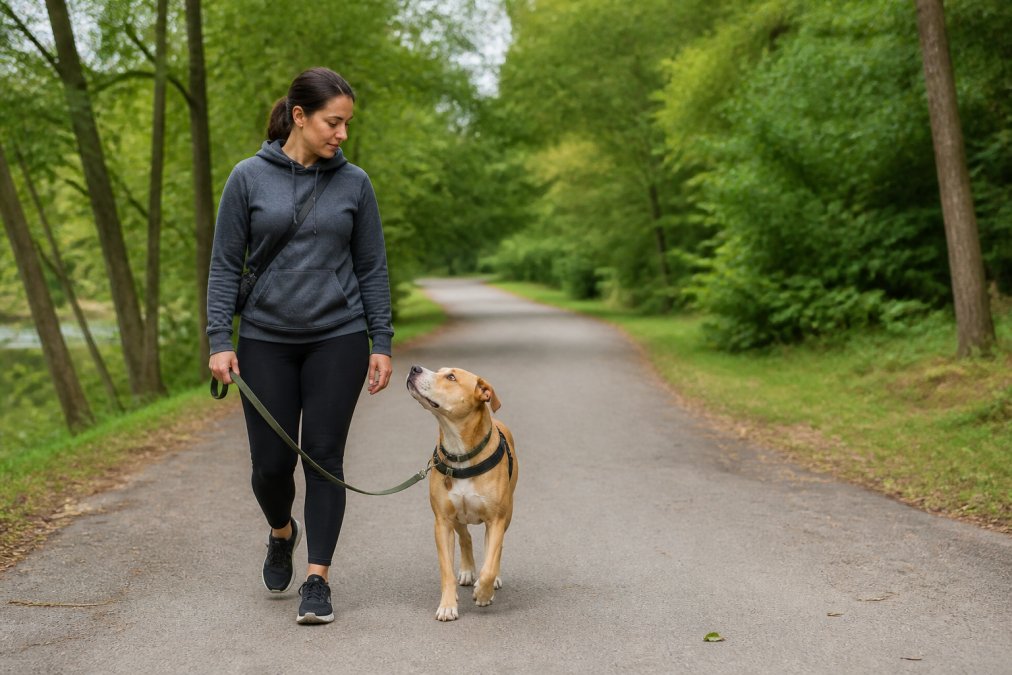
Where and when you walk matters enormously. A reactive dog on a busy street at peak hours is set up to fail. The same dog on a quiet residential path at dawn might have a completely different experience.
Low-stress walking conditions:
- Quiet times: early morning or late evening
- Quiet routes: residential streets, parks during off-peak hours, trails without heavy foot traffic
- Predictable paths where you know what to expect
- Escape routes where you can step aside or turn around
- Appropriate distance from other people or dogs
Equipment that supports safety without aversive tools
The right equipment makes a real difference. You need tools that help you maintain control and create distance safely, without using methods that cause fear or pain.
Leash and collar choices:
- Standard 6-foot leash: Provides control without restricting movement. Avoid retractable leashes.
- Flat collar or front-clip harness: A front-clip harness redirects forward momentum without choking. Avoid prong collars, shock collars, and choke chains, these create fear and pain, which often increases reactivity.
- Double-clip option: Some handlers use both a collar and harness for extra security during high-stress walks.
Distance tools:
- Long line (15-30 feet): Gives your dog space while you maintain control.
- Slip lead: Quick to put on, though not ideal for extended walks.
The goal is control without force.
Building a Leash Reactivity Training Plan
Management keeps your dog safe. Training changes how your dog feels about triggers. The most effective approach combines counter-conditioning and desensitization with positive reinforcement.
Counter-conditioning and desensitization fundamentals
Counter-conditioning teaches your dog to feel differently about a trigger: "other dog = good things happen" instead of "other dog = panic." Desensitization gradually exposes your dog to the trigger at a safe distance, then slowly decreases that distance. Together, they create real change.
How to set up counter-conditioning:
- Identify a trigger your dog reacts to.
- Find a distance where your dog notices the trigger but doesn't react yet, work at or just below threshold.
- The moment your dog notices the trigger, feed high-value treats (chicken, cheese, or your dog's favorite).
- Stop feeding when the trigger disappears.
- Repeat many times over weeks.
Positive reinforcement and marker training
Positive reinforcement means rewarding the behavior you want to see more of. If your dog looks at you instead of lunging at another dog, that's worth rewarding immediately.
Building a simple training plan:
- Week 1-2: Practice marker training in calm environments.
- Week 3-4: Practice at a distance from triggers. Mark and reward when your dog notices a trigger but doesn't react.
- Week 5+: Gradually decrease distance as your dog improves. This takes weeks or months, not days.
How to Calm a Reactive Dog on a Walk
Even with management and training, reactions happen. You need strategies to handle the moment itself and help your dog recover.
Emergency U-turn dog training for immediate redirect
When your dog is about to react or is already reacting, an emergency U-turn is your fastest exit. This is literally turning around and walking the other direction.
How to train an emergency U-turn:
- On a calm walk, suddenly turn around and walk the other direction. Immediately reward your dog.
- Repeat 5-10 times per walk for a week in calm situations.
- Your dog learns: "When handler turns around, something good happens."
- When you see a trigger approaching, turn around before your dog reacts.
Managing leash tension and your own emotional state
Your dog feels your tension through the leash. If you're anxious, your dog picks it up. Keep a loose leash during calm moments, a tight leash signals worry. When a trigger appears, don't jerk or yank; instead, create distance with a U-turn or by stepping to the side. If your dog pulls, stop moving and wait for slack before moving away.
Post-Reaction Recovery and Building Handler Confidence
After a reaction, your dog needs time to settle. So do you.
Immediately after a reaction:
After you get home:
Building your confidence:
Walking Your Reactive Dog at Night or in Low-Visibility Conditions
Night walks create unique challenges for reactive dogs. Reduced visibility increases uncertainty and startle reactions, makes it harder to read your dog's body language, and may make your dog feel less secure.
When to Seek Professional Help
Talk to your veterinarian if:
Your dog's reactivity appeared suddenly, is escalating despite training, has involved biting, or seems fearful, anxious, or in pain.
Celebrating Small Wins on Every Walk
The reactive dog parent's journey isn't linear. What matters is that you're showing up, learning how your dog communicates, building new habits, staying calm, and choosing management and reward-based training. Every walk where your dog doesn't react is a win. Every walk where your dog reacts but you handle it calmly is a win. Your dog is not broken. Their reactivity is communication. And you're learning to listen.
Frequently Asked Questions
What are the signs that my dog is becoming overstimulated during a walk?
Overstimulation in reactive dogs often shows through stiff body posture, intense staring or fixation, rapid breathing, tail tension, and ears pinned back. Some dogs may pace, whine, or pull hard on the leash. Others display wide eyes or a tucked chin. These stress signals tell you your dog is approaching or past their threshold and needs immediate distance or a redirect. Learning to spot these early signs helps you manage the situation before a full reaction occurs.
How does a leash reactivity training plan differ from general obedience training?
Leash reactivity training focuses specifically on behavior modification around triggers rather than basic commands. It involves counter-conditioning your dog to associate the presence of other dogs, people, or stimuli with positive outcomes like treats or play. A training plan addresses your dog's emotional state, not just obedience, and uses distance and threshold management to prevent reactions while building new associations. This is fundamentally different from teaching sit or stay.
How can I help my dog stay under threshold during walks?
Staying under threshold means keeping your dog far enough from triggers that they notice them but remain calm enough to focus on you. This requires knowing your dog's flight zone—the distance at which they can see a trigger without reacting. Start walks in quiet areas, use parallel walking when possible to avoid head-on encounters, and reward calm behavior generously. Gradually reduce distance over weeks or months as your dog builds confidence. Every dog's threshold is different, so patience and observation matter more than speed.
When should I consult a professional for leash reactivity?
Contact a certified behavior consultant or veterinary behaviorist if your dog shows escalating aggression, has bitten or nearly bitten, displays sudden behavioral changes, or if reactivity is worsening despite your efforts. Also seek help if you're unsure whether the behavior involves fear, pain, or aggression, or if your dog's reactivity is affecting your ability to manage them safely. A professional can assess your individual dog, rule out medical causes, and create a tailored behavior modification plan.