

How Dogs Speak With Their Ears: A Guide to Ear Signals
Table of Contents
- Dogs Speak With Their Ears: The Basics of Canine Communication
- Ears Forward and Erect: Alertness and Interest
- Ears Pinned Back: Understanding Fear and Submission
- Neutral Ear Position: Reading a Calm and Relaxed State
- Signs of Stress in Dogs: What Ear Signals Reveal
- Dog Body Language Chart: Ears in Context With Other Signals
- Age-Related Changes in Ear Communication
- Putting It All Together: Reading Your Dog's Ears
- Social Caption
- Frequently Asked Questions
Last Updated: October 2, 2026
Dogs Speak With Their Ears: The Basics of Canine Communication
Your dog is talking to you right now. Not with barks or whines, but with their ears. Every shift, twitch, and angle sends a message about what they're feeling and what they need. Understanding how dogs speak with their ears is one of the most powerful tools a dog parent can develop.

Whether your dog's ears are perked forward in curiosity or pinned flat against their head in fear, those movements are real communication. Learning to read them changes everything about how you respond to your dog.
The ears are packed with muscles and nerve endings and often broadcast your dog's emotional state before any other body signal. A dog's ears move independently of each other, allowing them to track sounds and express nuanced feelings simultaneously.
Why Ears Matter in Dog Body Language
Ears are one of the first signals other dogs notice. Forward, alert ears draw attention; pinned-back ears signal submission or fear. This non-verbal communication keeps dogs safe and helps them navigate social situations.
Reading ears tells you your dog's intent, emotional state, and stress level, information that matters for safety, training, and trust.
The Ear Muscles Behind the Movement
Dogs have 32 muscles controlling their ears, letting them rotate nearly 180 degrees and aim them independently. This anatomy makes ear signals detailed and honest.
Calm dogs have relaxed ear muscles; stressed or alert dogs show tension in how quickly and sharply their ears move.
Ears Forward and Erect: Alertness and Interest
Forward, erect ears signal attention and interest. Your dog has noticed something and wants more information.
A dog with forward ears is engaged and interested. In training, this position often means your dog is ready to work and focused on you.
Forward ears don't always mean happiness. A dog with forward, stiff ears and a tense body might be assessing a threat. Context matters, look at jaw tension, eye contact, tail position, and overall posture.
Ears Pinned Back: Understanding Fear and Submission
Pinned-back ears are one of the clearest appeasement signals a dog can give, communicating "I'm not a threat."
This ear position often appears with lowered head, tucked tail, soft eyes, or a play bow, signals dogs use to de-escalate tension.
Fear and submission often appear together. A fearful dog pins ears back to signal they're not aggressive; a submissive dog does the same to show respect or avoid conflict.
Pinned ears don't always mean terror. Some dogs naturally carry their ears this way, and some pin them back when excited or playing. Context is everything.
Neutral Ear Position: Reading a Calm and Relaxed State
A neutral ear position signals that your dog is calm and not alarmed or overstimulated.
Neutral ears vary by breed and individual dog. Learn what neutral looks like for your specific dog.
When your dog's ears are neutral, the rest of their body usually is too. Soft eyes, relaxed mouth, easy breathing. This is the state you want to see during training, on walks, and at home. It means your dog feels safe.
Signs of Stress in Dogs: What Ear Signals Reveal
Stress shows up in the ears first. A stressed dog's ears may twitch, rotate rapidly, or move in unusual patterns, sometimes pinning back and popping forward repeatedly, a sign of internal conflict.
Stressed ears often appear with yawning, lip licking, whale eye, or a tucked tail. Multiple stress signals together mean your dog is overwhelmed and needs space.
Rapid Ear Movements and Tension
Rapid ear movements signal that your dog's nervous system is activated and they're processing a threat or stressor.
In a reactive dog, rapid ear movements often come before a bark or lunge. If you catch the ear movement, you may be able to redirect your dog before they escalate.
Asymmetrical Ear Positions
When one ear is forward and one is back, your dog is in conflict, interested but also cautious or afraid. Asymmetrical ears often appear in anxious or reactive dogs processing complex situations.
This ear position is honest. Your dog isn't sure what to do. Respect that conflict and give your dog time to process.
Dog Body Language Chart: Ears in Context With Other Signals
Ears don't tell the whole story. Read them alongside tail position, body posture, mouth tension, and eye contact. A dog with forward ears and a wagging tail is very different from one with forward ears and a stiff, high tail.
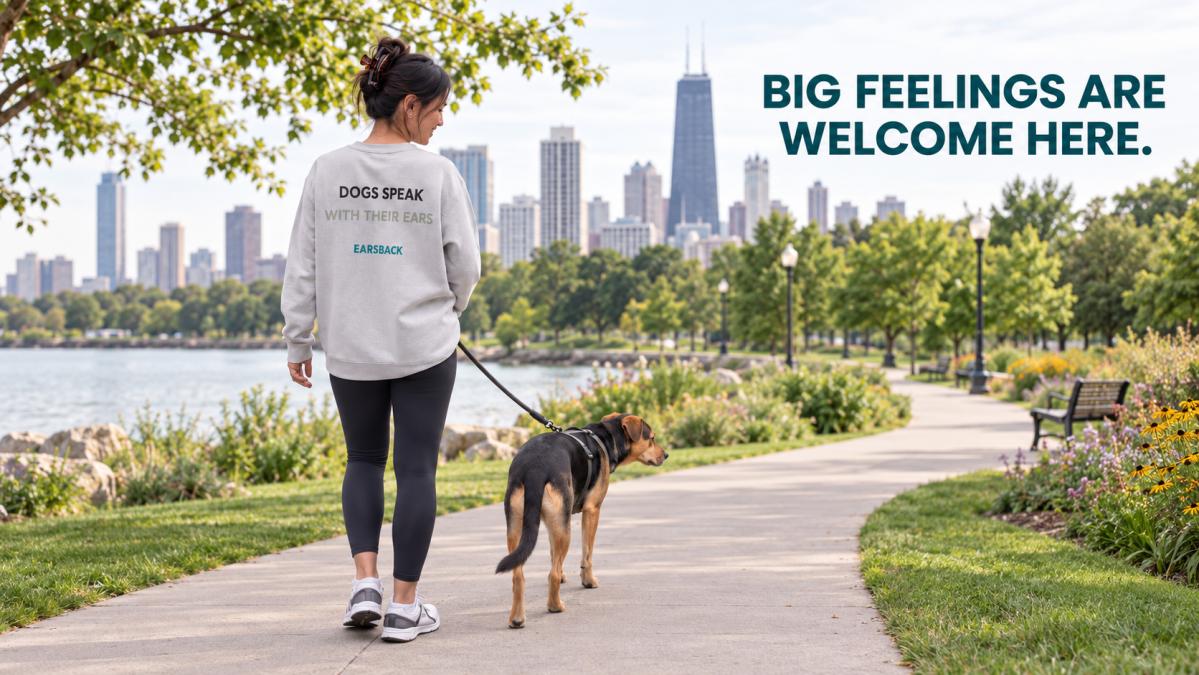
Reading body language means reading the whole dog. Here's how the pieces fit together:
EARSBACK Signature Dog Lover Crewneck →
Forward ears + relaxed body + soft eyes + loose tail = Curiosity or friendliness
Forward ears + tense body + hard eyes + stiff tail = Arousal or potential threat assessment
Pinned ears + lowered head + tucked tail + soft eyes = Fear or submission
Pinned ears + forward lean + tense body + hard eyes = Conflict, scared but defensive
Neutral ears + relaxed body + soft mouth + easy breathing = Calm and content
Rapid ear movement + whale eye + lip licking + tucked tail = Stress or anxiety
The Ear-Tail Connection
Your dog's ears and tail work together, reflecting overall arousal level and emotional state. When one goes up, the other often follows.
Forward ears and a high, stiff tail signal high arousal and potential reactivity. Pinned ears and a tucked tail signal low arousal and fear.
Breed-Specific Ear Anatomy and Limitations
Breed-specific ear anatomy affects how clearly ear signals come through.
Dogs with naturally floppy ears (Beagles, Cocker Spaniels, Basset Hounds) have limited ear mobility and more subtle signals. Look for ear tension and slight rotations rather than dramatic movements.
Dogs with naturally erect ears, German Shepherds, Siberian Huskies, Corgis, have more dramatic ear signals. Their ear movements are easier to read.
Dogs with cropped ears have lost part of their ear anatomy. They can't move their ears as much, so they rely more heavily on other body language signals.
Don't assume all dogs communicate ear signals the same way. Learn what normal looks like for your dog's breed and individual anatomy.
Age-Related Changes in Ear Communication
Puppies' ears are floppy and not fully under muscular control. As they grow, ear muscles develop and become more precise. Adult dogs have full ear mobility and clarity.
Senior dogs' ear movements may slow down. Arthritis or muscle weakness can limit how quickly or dramatically their ears move. A senior dog's ears might not pop forward as sharply as they used to, but the signals are still there.
Age also changes emotional responses. An older dog may be calmer overall, with less dramatic ear movements. A young, high-energy dog might have more exaggerated ear signals.
Putting It All Together: Reading Your Dog's Ears
Start paying attention. On your next walk, watch your dog's ears. Notice when they go forward, back, sideways, or stay neutral. Notice how they move in response to different triggers.
Your dog is always talking.
Social Caption
Dogs speak with their ears, and learning to read them changes everything. Forward ears mean curiosity. Pinned ears signal fear. Neutral ears show calm. In this guide, we break down exactly what your dog's ears are telling you, why breed matters, and how to read ear signals alongside other body language. Understanding your dog's communication builds trust, keeps them safe, and helps you show up better every single day.
[https://earsback.co/blog/how-dogs-speak-with-their-ears]
#DogBodyLanguage #ReactiveDogsUnited #DogCommunication #DogParents #EarSignals #DogBehavior #KindDogTraining #EARSBACK
Frequently Asked Questions
What does it mean when a dog pins their ears back?
Pinned-back ears often signal fear, anxiety, or submission. A dog may flatten their ears when they feel threatened, uncertain, or are trying to appear less intimidating to another dog or person. However, context matters, some dogs pin their ears back during play or when they're simply relaxed. Look at the whole picture: body posture, tail position, and facial expression help you understand what your dog is actually communicating.
Can ear position indicate if a dog is feeling anxious?
Yes, ear position is one sign of anxiety in dogs. Anxious dogs often show asymmetrical ears (one forward, one back), rapid ear movements, or ears held slightly to the side. Combined with other stress signals like a tucked tail, whale eye, lip licking, or tension in the body, ear position helps you recognize when your dog feels overwhelmed. If you notice these signs regularly, especially during specific situations, consider consulting with a qualified professional.
Are ear signals the same for every dog breed?
Not entirely. Dogs with floppy ears, cropped ears, or other conformation differences may have limited ear mobility or visibility, so they rely more heavily on other body language signals like tail position and facial expression. Breed-specific ear anatomy affects how clearly you can read ear movement. For example, a dog with naturally drooping ears may appear sad even when relaxed. Always consider your dog's individual anatomy alongside their other body signals to interpret their emotional state accurately.
How do dogs use their ears to show they are listening?
Dogs orient their ears toward sounds they're interested in or trying to locate. When your dog is focused on you or something that catches their attention, you'll often see their ears perk up and rotate slightly toward the source of the sound. This auditory focus is part of their alertness and engagement. Combined with forward-facing ears and a direct gaze, ear orientation shows your dog is paying attention and ready to respond, a key signal in the dog-parent bond.